
Blog
|
Learn
What Is the ASES Program? Complete Guide for California Schools
Learn how California's After School Education and Safety grants fund after-school programs for elementary and middle school students.
On this page:
If your child attends a public elementary or middle school in California, there's a good chance an after-school program is available right on campus.
And there's an even better chance it's funded, at least in part, by something called ASES.
Whether you're a parent looking for after-school options, or a school administrator exploring grant opportunities, here's how the ASES program works and why it matters.
What is the ASES program?
The After School Education and Safety (ASES) program is California's largest state-funded after-school initiative.
It provides grants to public schools and charter schools so they can offer free, structured programming that combines academic support with enrichment activities like arts, sports, and STEM. With $794 million in current statewide funding, ASES reaches hundreds of thousands of students every year.
The ASES program is for students in transitional kindergarten (TK) through ninth grade. It was created through Proposition 49, a voter-approved ballot measure that expanded California's investment in after-school education.
Proposition 49 amended California Education Code Section 8482, transforming an earlier before-and-after-school program into the broader ASES initiative we have today.
The expansion had two goals: maintain existing program funding and extend eligibility to all elementary and middle schools capable of submitting quality applications.
The program is administered by the California Department of Education's Expanded Learning Division and operates through Local Educational Agencies (LEAs), including public school districts and direct-funded charter schools.
What makes ASES different from simple childcare is the structure. Every ASES program is required to include both an academic component and an enrichment component.
The goal is to provide students with homework help, tutoring, and access to activities that go well beyond what the regular school day can offer.
Who qualifies for ASES programs?
Students
Every student attending a school with an ASES program is eligible to participate, subject to capacity. When programs have more interested families than available spots, enrollment follows a priority system.
Students experiencing homelessness, youth in foster care, students eligible for free or reduced-price meals, and English Language Learners receive first priority.
After that, spots go to middle school students who commit to attending daily and students meeting USDA income eligibility guidelines. From there, programs look at students who need academic support and those who will attend the full range of program hours.
If there's still space, additional students are selected through random draw or site-based criteria.
Many programs maintain waitlists, so even if your child doesn't get in right away, it's worth staying on the list. Spots open up throughout the year as families move or schedules change.
Schools
Elementary and middle schools across California can apply for ASES funding through a competitive grant process. Schools where 50% or more of students qualify for free or reduced-price meals get priority consideration.
Larger schools, specifically elementary schools with more than 600 students and middle schools with more than 900, may qualify for additional funding beyond the base grant amount.
What happens in an ASES program?
ASES programs are required to deliver two core components every day: educational support and enrichment. The balance between the two varies by site, but both have to be present.
Academic support
This is the structured part of the afternoon. Students get dedicated time for homework completion, academic tutoring in subjects like reading, math, science, and social studies, and small-group or individualized instruction. Many programs pair students with mentors or tutors who build ongoing relationships throughout the year.
The academic component is designed to reinforce what's happening during the school day, not replace it. For a struggling reader, that might mean extra time with a literacy tutor. For a student who's ahead, it might mean enrichment projects that go deeper into topics they're interested in. The goal is to meet each student where they are.
Enrichment activities
This is the part that makes students actually want to show up. Enrichment programming varies widely from school to school, but it typically includes some mix of STEM and STEAM activities, visual and performing arts, physical fitness and sports, community service projects, career exploration, and health and nutrition education.
Many ASES sites partner with outside organizations to bring in specialized programming. A school might work with a STEM education company like All Things Science to run hands-on STEM clubs in subjects like robotics, chemistry, or engineering.
Others partner with local arts organizations, sports leagues, or community nonprofits. These partnerships let programs offer a wider range of activities without putting the full burden on school staff.
The enrichment component also plays an important role in social-emotional development. Team sports, collaborative projects, and service-learning activities all help students develop and learn how to work with their peers.
ASES program funding
The current ASES allocation is $794 million statewide.
Individual school sites receive base grants of up to $112,500 per year.
Larger schools can receive additional funding calculated by multiplying $113 by each student above the size threshold.
So an elementary school with 700 students (100 over the 600-student threshold) would receive roughly $123,800.
Supplemental funding is also available in some cases. Frontier Transportation Grants, for example, help existing ASES grantees cover transportation costs in rural areas. And existing grantees sometimes have the opportunity to apply for additional sites or increased funding as new dollars become available.
ASES grants are renewed every three years. To stay eligible for renewal, programs need to submit attendance and expenditure reports on time, complete evaluation requirements, and resolve any audit or compliance findings.
Programs that fall out of good standing risk losing their funding, so staying on top of reporting is critical.
ASES vs. ELOP vs. 21st CCLC
California has several expanded learning funding sources, and many schools use more than one. Here's how the three main programs compare.
ASES is state-funded through Proposition 49 and serves transitional kindergarten through ninth grade. It provides three-year renewable grants with a focus on schools with high percentages of students eligible for free or reduced-price meals. Current statewide funding is $794 million.
ELOP (Expanded Learning Opportunities Program) is also state-funded and targets transitional kindergarten through sixth grade. Schools meeting certain criteria are required to offer ELOP programming. ELOP can be combined with ASES through cost-sharing arrangements, which gives schools more flexibility in how they structure their programs and allocate resources.
21st CCLC (21st Century Community Learning Centers) is federally funded through ESSA and covers K-12. It awards five-year competitive grants and requires a family engagement component. The program specifically targets high-poverty, low-performing schools.
These funding sources work well together. A school might use ASES as its foundation for after-school programming, layer in ELOP to extend hours or add summer programming for younger students, and bring in 21st CCLC funding to expand enrichment and add family literacy services.
Understanding how these programs overlap helps schools build the most comprehensive programming possible.
Does the ASES program work?
It does, and families can feel it. Research and program data show that students who regularly participate in ASES programs see real benefits. They complete homework more consistently, show improvements in reading and math, attend school more regularly, and develop stronger relationships with peers and adults.
The social-emotional side matters just as much. Students in ASES programs build teamwork skills, gain confidence, and develop a stronger sense of belonging at school.
For many families, especially working families, knowing that their child is in a safe, supervised environment with meaningful activities makes a significant difference.
Many districts report that over 90% of parents express satisfaction with their school's ASES program and observe improvements in their children's academic performance and social skills.
That kind of feedback speaks to the program's real-world impact beyond what test scores alone can measure.
How to find and enroll in an ASES program
If you're a parent interested in enrolling your child, the process is straightforward.
Start by asking at your child's school. Check with the front office or your child's teacher to find out whether the school operates an ASES program. Most schools that have one will promote it during back-to-school events and through materials sent home with students.
From there, request program information. Ask for the program handbook, daily schedule, and any enrollment requirements. This will give you a clear picture of what the program offers and what's expected of participating families.
Registration periods vary by school and district, but many programs open enrollment in the spring for the following school year.
Complete the required forms during the enrollment window, and if the program is full, ask to be placed on the waitlist. Spots frequently open up as the year progresses.
Once your child is enrolled, stay engaged. Attend parent events, participate in program surveys, and communicate with staff about how things are going. Programs rely on family feedback to improve, and your involvement helps make the program better for everyone.
STEM programs with All Things Science
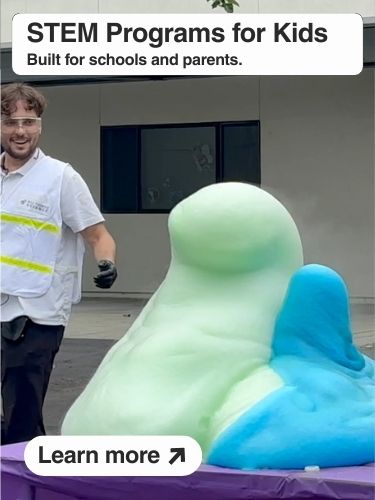
If your school runs an ASES program and you are looking to strengthen the enrichment component, All Things Science partners with schools and expanded learning programs across California to deliver hands-on STEM programs that students enjoy and parents value.
All Things Science runs weekly after-school clubs, in-school labs, and summer programs directly on campus. Schools can expand their STEM offerings without taking on additional staffing, materials, or logistical burden.
ASES program FAQ
What does ASES stand for?
After School Education and Safety. It's California's largest state-funded after-school program, serving students in transitional kindergarten through ninth grade.
Is the ASES program free?
Yes. ASES programs are free for all participating students and families.
Who is eligible for an ASES program?
Every student at a school with an ASES program can participate, subject to capacity. Priority goes to students experiencing homelessness, foster youth, students eligible for free or reduced-price meals, and English Language Learners.
How is ASES different from ELOP?
ASES is funded through Proposition 49 and serves TK through 9th grade with three-year renewable grants. ELOP is a separate state-funded program for TK through 6th grade. Schools can combine both funding sources.
How is ASES different from 21st CCLC?
ASES is state-funded and focuses on elementary and middle schools. 21st CCLC is federally funded, covers K-12, awards five-year grants, and requires a family engagement component. Many schools use both programs together.
What activities do ASES programs offer?
Programs include homework help and academic tutoring plus enrichment activities like STEM, arts, sports, career exploration, and social-emotional learning.
How do I enroll my child?
Contact your child's school to ask if they operate an ASES program. If they do, request enrollment information and complete registration forms during the open enrollment period. If the program is full, ask to be placed on the waitlist.
Hands-on STEM for parents and schools
Give your students access to great after-school STEM programs year-round
Get started ➔


.jpg)
Take a Look at our Featured Articles
Dive into the vibrant world of STEM through articles from your favorite scientists and engineers, all in one place.


Join the 1000+ families enrolled in All Things Science
Tell us where to send you some free STEM resources today.


