
Blog
|
9 Popular STEM Programs for Kids
Explore popular STEM programs for kids, including after-school programs, in-school STEM labs, summer STEM camps, and more.

On this page:
With the growing emphasis on STEM education in schools, parents and educators are increasingly looking for ways to bring hands-on learning into students’ academic schedules. STEM programs have become a popular option for giving students more meaningful opportunities to explore science, technology, engineering, and math in ways that match their interests and abilities.
STEM programs for kids come in a wide range of formats and schedules. Some meet regularly after school, others are integrated into the school day, and some take place during school breaks or on weekends. Each format can focus on different subjects, project styles, and learning experiences.
This article is designed to help you understand the different types of STEM programs available, how they vary in structure and day-to-day experience, and what factors to consider when deciding which option may be the best fit for your child or school.
What is a STEM program?
In practice, a STEM program is a scheduled learning experience where kids work through science, technology, engineering, or math projects outside of their regular classroom lessons. These experiences are often described as STEM enrichment programs because they extend learning beyond the standard school curriculum through hands-on activities like building, experimenting, coding, and testing ideas with real materials.
STEM programs are often defined more by how and when they run than by a single subject. Some meet weekly as after-school clubs, others rotate through classrooms during the school day, and some operate as short, intensive programs during school breaks. The structure, time commitment, and setting can vary significantly, even when two programs focus on similar topics.
Because of this, the term “STEM program” can describe many different experiences. Understanding whether a program functions as an enrichment opportunity, a classroom supplement, or an immersive camp is often more helpful than the label itself when deciding if it is a good fit for a child or a school.
How to Know if a Program Is STEM
Not every program labeled “STEM” looks the same, and the name alone does not always tell you much. A true STEM program usually centers on activities where kids actively work with scientific ideas, technology tools, engineering challenges, or math-based problem solving. This might include building physical projects, testing experiments, writing simple code, or designing solutions to real-world problems.
It also helps to look at what students are actually doing during the program, not just the subject title. Programs that focus on creating, testing, revising, or troubleshooting tend to fall squarely within STEM, while programs that are mostly lecture-based or worksheet-driven often do not.
Some programs you encounter may be described as STEAM education programs, which include art or design elements alongside science, technology, engineering, and math. These programs can still be a strong fit for many kids, especially those who enjoy craft or art projects. If you are deciding between the two, you can learn more about how they differ in our STEAM vs STEM comparison.
9 types of STEM programs by subject area
STEM programs for kids usually focus on specific topics or combine multiple subjects within those categories into a well-rounded curriculum.
When deciding which STEM program is right for your students or school, here are nine core subject areas that strong STEM programs often offer.
1. Rocketry programs
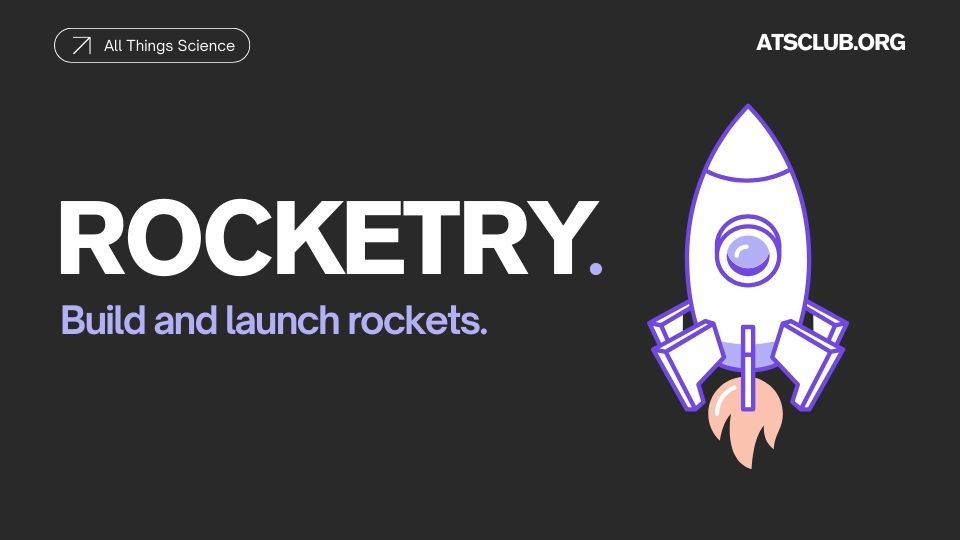
Rocketry programs help kids learn how rockets fly by exploring forces like thrust, gravity, and air resistance. Students apply these ideas by designing and building their own rockets that must stay stable, fly straight, and land safely. Students also see how size, weight, fin placement, and materials affect rocket performance.
Rocketry STEM programs give elementary and middle school students hands-on experience with the engineering process. By designing, building, and testing rockets with classmates, students build problem-solving skills and develop an early interest in aerospace and space exploration.
2. Robotics programs
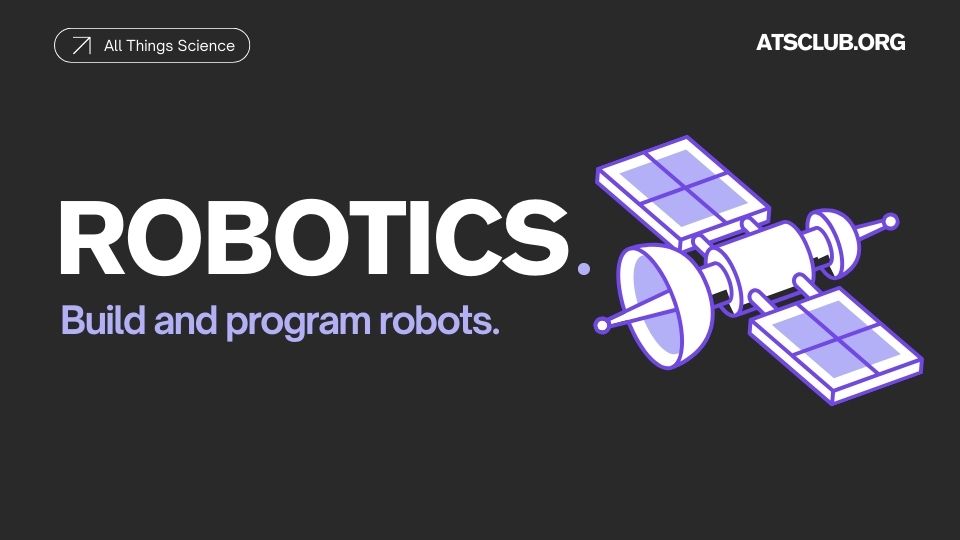
Robotics programs introduce students to core concepts by building and programming robots using sensors, motors, and movement, as well as simple machines like gears and linkages. Elementary and middle school students learn basic coding skills and see their code in action as they program robots to complete challenges, avoid obstacles, and refine their designs to improve performance.
Robotics STEM programs are a strong way to connect coding, engineering, and mechanics to real-world technology students will encounter in future careers. Through team-based projects, students build problem-solving skills while learning to collaborate and iterate on their designs.
3. 3D printing programs
3D printing programs introduce students to the fundamentals of 3D printing technology and materials while exploring core design and engineering principles through the creation of three-dimensional models.
3D printing STEM programs for kids help elementary and middle school students connect design thinking to real-world applications in fields like aerospace, robotics, and architecture. By designing and creating original models they can take home, students build spatial reasoning, fine motor skills, and confidence in their work.
4. Circuits programs
Circuits programs and electronics programs introduce students to how electrical systems work through hands-on building and experimentation. Elementary and middle school students learn core concepts like current, voltage, and resistance while exploring the difference between open and closed circuits.
Using batteries, wires, LEDs, switches, buzzers, and motors, students build working circuits that power lights, fans, and sound devices. These projects help students see how electricity and energy are used in real-world electronics through practical, hands-on experience.
5. Biology programs
Biology programs introduce students to core life science concepts such as cells, body systems, plants, animals, and ecosystems while teaching them how scientists use tools like microscopes and observation journals. Through guided investigations, students examine plant structures, build models of human body systems, and create mini ecosystems to observe how living things grow, adapt, and interact with their environment.
Biology STEM programs for kids help elementary and middle school students connect science to the natural world around them. By asking questions, collecting data, and testing ideas, students develop foundational skills in scientific thinking and experimentation.
6. Chemistry programs
Chemistry programs introduce students to the properties of matter, the difference between physical and chemical changes, and the basics of atoms, molecules, and chemical reactions. Elementary and middle school students take part in guided experiments that use safe materials to help them understand how and why substances change, connecting abstract chemistry concepts to real-world experiences.
7. Engineering programs
Engineering programs for kids introduce students to the design process engineers use to solve real-world problems. Elementary and middle school students learn how to plan, build, test, and improve hands-on projects and structures through guided challenges.
By exploring core engineering concepts such as balance, tension, compression, and motion, students design and build bridges, towers, vehicles, and other mechanical systems that must meet real design constraints. These projects help students understand how engineering principles are applied in practical, real-world situations.
8. Physics programs
Physics programs are not just for high school or college students. Core physics concepts can be introduced to elementary and middle school students in age-appropriate, hands-on ways. Physics programs for kids explore ideas such as gravity, friction, inertia, and energy through projects that involve designing, building, and measuring distance and speed.
These programs pair naturally with math enrichment by giving students opportunities to record data, test ideas, and analyze results while working on hands-on projects that bring abstract concepts to life.
9. Coding programs
Coding programs introduce students to the fundamentals of computer science through hands-on, creative projects. Elementary and middle school students learn core concepts such as sequences, loops, and conditionals while using age-appropriate coding tools to build interactive programs.
Through activities like creating games, animations, and simulations, students learn how to plan, write, test, and debug code. Coding STEM programs for kids help students understand how technology works while developing problem-solving skills and computational thinking they can apply across many subjects.
Types of STEM Programs for Kids
STEM programs for kids are designed to introduce science, technology, engineering, and math through hands-on learning experiences that fit different schedules and learning environments. While all STEM programs focus on active exploration and problem solving, the structure of each program shapes how students engage with the material and how deeply they can explore specific topics.
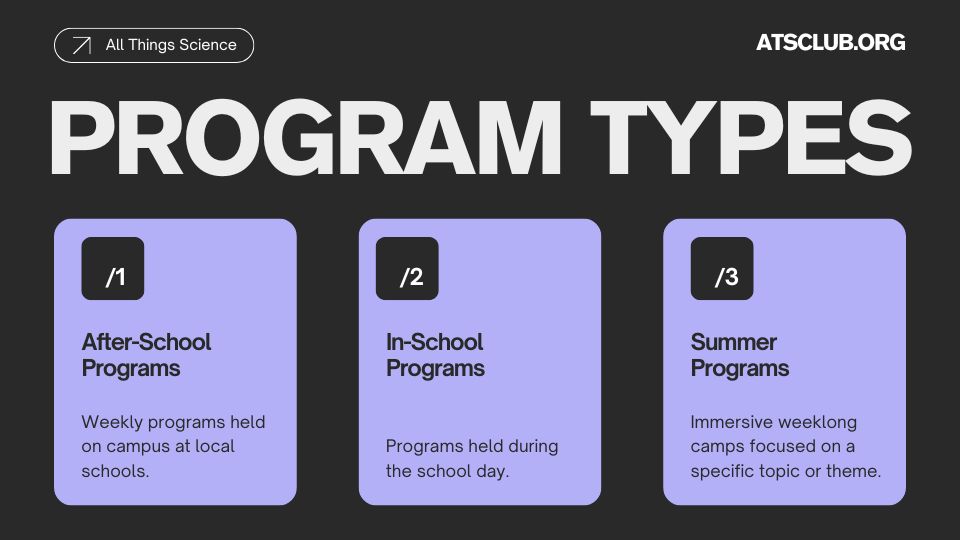
Today, families and schools can choose from several types of STEM programs, including after-school programs, in-school programs, and summer programs. Each format offers unique benefits depending on student age, interests, and availability.
Understanding the different types of STEM programs can help parents and educators choose the option that best supports student learning and enrichment goals.
After-school STEM programs
STEM after school programs provide structured enrichment outside of the regular school day. These programs are typically held on campus and run as weekly sessions over multiple weeks.
Students participate in hands-on STEM activities such as engineering challenges, coding projects, and science experiments while collaborating with classmates. Because learning happens over time, after-school STEM clubs allow students to practice skills, revisit concepts, and improve their designs through iteration.
After school STEM programs are especially popular with families seeking consistent enrichment and with schools looking to offer engaging STEM programs for elementary and middle school students.
In-school STEM programs
In-school STEM programs take place during the school day and are designed to complement academic instruction. These programs may be offered as dedicated STEM classes, year-round STEM labs, or short-term STEM workshops aligned with grade-level standards.
By bringing hands-on learning into the classroom, in-school STEM programs help students apply science and engineering concepts through experiments, design challenges, and real-world problem solving. This format allows schools to expand access to STEM learning while reinforcing core academic skills.
In-school STEM programs are often used to support curriculum goals while exposing students to a broader range of STEM subjects.
Summer STEM programs
STEM summer programs offer immersive learning experiences during school breaks, most commonly through STEM camps. These programs typically run for full or half days over one or more weeks and focus on a specific STEM theme.
STEM camps allow students to explore topics like robotics, engineering, chemistry, coding, or rocketry in greater depth. With longer daily sessions, students can complete larger projects, test ideas, and build confidence through extended hands-on learning.
Families often find STEM camps hosted at school campuses, community centers, and enrichment facilities. STEM camps are a popular option for keeping kids engaged during school breaks while encouraging creativity, exploration, and skill development.
Additional seasonal STEM programs
Winter programs
Winter STEM programs offer short, hands-on learning experiences during winter break. These programs are often run as camps or workshops and help students stay engaged while school is out.
Spring programs
Spring STEM programs are typically offered during spring break or as brief enrichment sessions near the end of the school year. They provide a low-commitment way for students to explore STEM topics before summer.
Fall programs
Fall STEM programs usually run at the beginning of the school year and are commonly offered as weekly after-school programs. These programs help students build skills and routines through consistent, hands-on learning.
Choosing a STEM program: Checklist
For parents and families
Age-appropriate grouping
STEM programs work best when students are grouped by age or grade level. This helps ensure activities feel challenging but achievable and keeps students engaged rather than frustrated or bored.
Hands-on learning
Look for programs where students spend most of their time building, experimenting, and creating. Strong STEM programs emphasize doing over watching and allow students to learn through trial and error.
Clear structure
Programs should clearly explain what students will work on and how sessions are organized. A predictable structure helps students feel comfortable while still leaving room for creativity and exploration.
Consistent schedule
Choose a program format that fits your family’s routine, whether that is an after-school program, a weekend session, or a seasonal camp. Consistency makes it easier for students to stay engaged over time.
Positive learning environment
Smaller group sizes and supportive instructors make a big difference. Students are more likely to ask questions, collaborate, and build confidence when they feel encouraged and supported.
For schools and educators
Curriculum support
STEM programs should reinforce classroom learning without replacing it. Look for programs that complement grade-level standards and provide hands-on applications of science and math concepts.
Flexible program formats
Strong programs can adapt to different schedules, including in-school enrichment, after-school programs, or break-based camps. Flexibility helps programs fit smoothly into the school calendar.
Instructor experience
Experienced instructors help ensure sessions are engaging, well-managed, and safe. Instructors should be comfortable guiding students through open-ended projects and problem solving.
Logistics and materials
Programs that handle materials, setup, and cleanup reduce the burden on school staff. Clear logistics help ensure sessions run smoothly with minimal disruption to the school day.
Funding options
Many STEM programs can be supported through district and school funding, as well as PTAs, school foundations, enrichment budgets, or grants. Understanding available funding options can help schools offer programs to more students.
STEM program costs and funding options
STEM program costs can vary widely depending on the program format, length, subject matter, and level of instruction. Factors such as materials, equipment, class size, and instructor support all play a role in overall pricing.
After-school STEM programs are typically priced per session or per semester and often run once or twice a week over several weeks. These programs balance consistent enrichment with manageable costs for families and schools.
In-school STEM programs are usually funded at the school or district level. Pricing may be based on the number of classrooms, grade levels, or instructional hours, and programs are often supported through curriculum budgets or enrichment funding.
Summer STEM programs tend to have higher upfront costs due to longer daily schedules and more intensive projects. STEM camps are commonly priced by the week and may include specialized materials or equipment that students use throughout the program.
Common funding sources
STEM programs are supported through a variety of funding options, depending on the setting:
- Families and caregivers, through program registration or tuition
- PTAs, PTOs, PTSAs, and school foundations, using enrichment or fundraising budgets
- Schools and districts, through federal and state funds and grants designed specifically for enrichment or expanded learning opportunity programs.
Many schools and parent organizations use a combination of funding sources to make STEM programs more accessible to students.
When comparing STEM programs, it can be helpful to look beyond price alone and consider the value provided through hands-on materials, instructor support, class structure, and overall student experience.
How to enroll in a STEM program: Getting started
Getting started with a STEM program begins by choosing a format that fits your student’s age, interests, and schedule, such as after-school enrichment, in-school program, or seasonal camps.
Most STEM programs share details about subjects, activities, and schedules to help families understand what students will be working on. Enrollment may be open to families directly or coordinated through schools, PTAs, or enrichment partners, depending on the program.
Organizations like All Things Science partner with local schools to bring hands-on STEM programs directly to students and families in the community, ensuring a natural fit within a school’s existing after-school, in-school, or summer programming.
STEM programs FAQ
What are STEM programs?
STEM programs are structured learning experiences that focus on science, technology, engineering, and math through hands-on activities and projects. STEM programs for kids often emphasize building, experimenting, coding, and problem solving rather than traditional lectures.
What age are STEM programs for?
Most STEM programs are designed for elementary and middle school students, typically ages 5 to 14. Many programs group students by grade or age to ensure activities are developmentally appropriate and engaging.
What do kids learn in STEM programs?
Kids in STEM programs learn practical skills such as critical thinking, collaboration, and problem solving while exploring subjects like robotics, engineering, coding, science, and design. Programs often focus on applying concepts through real projects rather than memorization.
Are STEM programs after school or during the school day?
STEM programs can take place in many formats. Some are offered as after-school STEM programs, others are integrated into the school day as STEM labs or enrichment classes, and some run as STEM camps during school breaks.
What are STEM summer programs?
STEM summer programs are immersive learning experiences held while school is out, often in the form of STEM camps. These programs usually run for full or half days over one or more weeks and focus on specific topics such as robotics, engineering, coding, or science.
How much do STEM programs cost?
STEM program costs vary based on format, duration, materials, and location. After-school programs are often priced per session or semester, while STEM camps are typically priced by the week. In-school programs are commonly funded by schools, districts, or parent organizations.
Are there affordable or free STEM programs?
Some STEM programs are funded through schools, districts, PTAs, PTOs, or grants, which can reduce or eliminate costs for families. Availability depends on location and funding sources, so it is helpful to check with local schools or enrichment providers.
How do I find STEM programs near me?
STEM programs are often offered through local schools, enrichment providers, community centers, and summer camps. Searching for school-based STEM programs or after-school STEM programs in your area is a good place to start.
Are STEM programs good for beginners?
Yes. Many STEM programs are designed for beginners and do not require prior experience. Programs typically introduce concepts gradually and allow students to learn through guided exploration and trial and error.
How are STEM programs different from regular classes?
Unlike traditional classes, STEM programs focus on hands-on learning and project-based activities. Students spend more time building, testing, and experimenting, which helps them apply concepts in real-world ways.
Hands-on STEM for parents and schools
Give your students access to great after-school STEM programs year-round
Get started ➔


.jpg)
Take a Look at our Featured Articles
Dive into the vibrant world of STEM through articles from your favorite scientists and engineers, all in one place.


Join the 1000+ families enrolled in All Things Science
Tell us where to send you some free STEM resources today.


