
Blog
|
Learn
What Is a STEM Club? A Guide for Parents and Schools
Learn what STEM clubs are, what kids do in them, and how families and schools can find or start a STEM club.

On this page:
STEM clubs have become one of the most popular ways schools bring hands-on STEM education into students’ weekly routines. For parents, they offer an engaging enrichment option beyond the regular school day. For educators and administrators, they provide a flexible way to expose students to science, technology, engineering, and math without overhauling the core curriculum.
Whether a club meets after school, during an enrichment block, or as part of an extended learning program, STEM clubs give students space to explore, build, test ideas, and learn by doing. This guide walks through what a STEM club is, what students typically do in one, how schools get them started, and how families can find quality STEM clubs near them.
What is a STEM club?
A STEM club is a structured program where students explore science, technology, engineering, and math through hands-on projects rather than traditional lectures or worksheets. Most STEM clubs are offered outside the standard classroom schedule, often after school or during enrichment periods, and are designed to be exploratory and project-based.
Unlike a single science lesson or one-off activity, STEM clubs usually run over several weeks and follow a themed curriculum. For example, a club might focus on robotics, engineering design, circuits, chemistry experiments, biology, or 3D printing. Students work in small groups, use real tools and materials, and practice problem-solving in a low-pressure environment.
STEM clubs are commonly offered at the elementary and middle school level, where curiosity is high and students benefit most from hands-on learning experiences.
What do you do in a STEM club?

STEM clubs are built around active participation. Students are not just watching demonstrations. They are designing, building, testing, and revising their ideas.
Depending on the theme, students might:
- Build and program simple robots
- Design engineering structures and test their strength
- Create electrical circuits and learn how electricity flows
- Conduct chemistry experiments using safe lab materials
- Explore biology through hands-on investigations and models
- Use design tools like 3D pens or introductory 3D modeling software
Most clubs emphasize teamwork, iteration, and creativity. Students learn that it is okay when a project does not work the first time. They are encouraged to ask questions, make changes, and try again. This process mirrors how real scientists and engineers work and helps students build confidence along with technical skills.
How to start a STEM club at your school
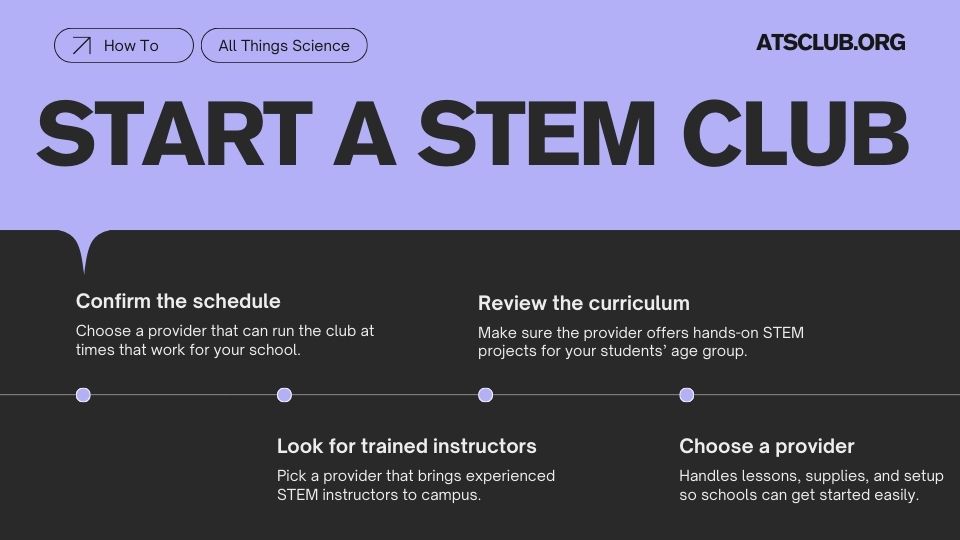
Starting a STEM club can feel overwhelming at first, especially for schools balancing busy schedules and limited staff time. In reality, most successful STEM clubs come together by choosing the right provider and following a few simple steps.
Confirm the schedule and location
First, the school confirms when and where the club will run. Most elementary and middle school STEM clubs meet after school for about one hour each week over an eight to ten week session.
Choose who will run the club
Next, the school selects a provider to run the club. Rather than relying on teachers to take on extra responsibilities, many schools work with STEM education providers that bring trained instructors to campus.
Review the curriculum
Curriculum is another key consideration. A strong provider offers age-appropriate, hands-on STEM lessons with clear learning goals that fit the program schedule.
Partner with a STEM company
To keep things simple, many schools partner with experienced organizations like All Things Science. An all-in-one STEM provider handles lessons, supplies, and setup so schools can launch a STEM club without adding extra work for teachers or administrators.
STEM club benefits
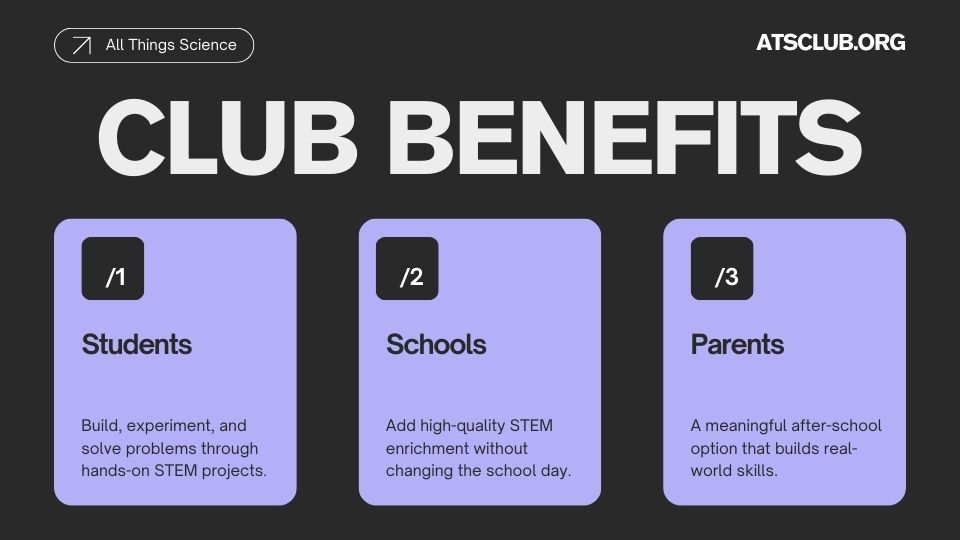
STEM clubs offer benefits that go beyond academics and support students, schools, and families in different ways.
Benefits for students
STEM clubs help students build problem-solving skills, creativity, collaboration, and persistence through hands-on projects. They allow students to actively explore science and engineering instead of just reading about them.
Benefits for schools
STEM clubs add high-quality enrichment without changing the core school day. They support student engagement, equitable access to STEM learning, and long-term college and career readiness goals.
Benefits for parents
STEM clubs give families a meaningful alternative to traditional after-school care. Parents value programs that are hands-on, educational, and connected to real-world skills students will use in the future.
How to find STEM clubs near you

Families and educators can find STEM clubs through several common channels. Schools often announce clubs through newsletters, flyers, or parent portals. PTAs and school foundations may also sponsor enrichment programs.
When evaluating a STEM club, it helps to look for programs that:
- Are taught by trained instructors
- Use hands-on materials and real experiments
- Offer age-appropriate curriculum for elementary or middle school students
- Run for multiple weeks rather than single sessions
Organizations like All Things Science work directly with schools to host on-campus STEM clubs, making it easier for families to access high-quality programs without traveling off site.
STEM clubs FAQ
What ages are STEM clubs for?
Most STEM clubs are designed for elementary and middle school students, often serving grades K through 8 with curriculum tailored to each age group.
How long do STEM clubs usually run?
Clubs typically meet once per week for 60 minutes and run for six to ten weeks per session.
Do students need prior experience?
No prior STEM experience is needed. Clubs are designed to welcome beginners and gradually build skills through hands-on projects.
Are STEM clubs aligned with school standards?
Many high-quality programs align activities with grade-level science and engineering standards, even though they are offered as enrichment.
Can a school start a STEM club without extra work for teachers?
Yes. Many schools partner with outside providers that handle instruction, curriculum, and materials, allowing teachers and administrators to focus on supporting students rather than running the program.
Hands-on STEM for parents and schools
Give your students access to great after-school STEM programs year-round
Get started ➔


.jpg)
Take a Look at our Featured Articles
Dive into the vibrant world of STEM through articles from your favorite scientists and engineers, all in one place.




Join the 1000+ families enrolled in All Things Science
Tell us where to send you some free STEM resources today.


