
Blog
|
Learn
What Is a STEM Lab? A Guide for Elementary and Middle Schools
Discover what a STEM lab is, how it works, and why it's essential for K–8 education. Learn about hands-on activities, benefits, and how to bring a STEM lab to your school.

On this page:
With the growing emphasis on STEM education in schools, parents and educators are increasingly looking for ways to bring hands on learning into students’ academic schedules.
In school STEM labs provide elementary, middle, and K–8 schools with a structured way to give students an early foundation in STEM, helping prepare them for future academic and professional opportunities.
This article is designed to help parents and school administrators understand what a STEM lab is, how it works, what students do in it, and how to get one set up on an elementary or middle school campus.
What is a STEM lab?

A STEM lab is a learning space where students explore science, technology, engineering, and math through hands on projects, experiments, and group activities.
These in school labs are typically led by a specialized STEM instructor who works across multiple grade levels, adapting lessons to meet the developmental needs of each group while ensuring the content and curriculum align with NGSS and state standards.
How do STEM labs work?
STEM labs can look different from school to school, but in most cases they operate on a rotating weekly schedule during regular school hours. Each classroom visits the lab once or twice a week, or once every few weeks depending on the school’s structure, so every grade level has the opportunity to participate.
During that time, students engage in lessons aligned with NGSS and state standards that correspond to what teachers are covering during that part of the year. The difference is the emphasis. STEM labs prioritize hands on projects, activities, and experiments that apply those standards in a practical way.
A typical class begins with a short 10 to 15 minute introduction to the day’s topic, followed by a hands on build or experiment. Students then test and refine what they created, and the final portion of the class is used to assess student understanding.
STEM labs generally operate in one of two formats. The first is a dedicated lab space on campus. Teachers bring their class to the lab at a scheduled time each week and transition instruction to the STEM instructor for that period.
The second format is a mobile STEM lab. In this model, the instructor brings all materials and supplies directly into each classroom, leads the lesson, and then rotates to the next class.
In most cases, a specialized STEM educator can teach three to five classrooms per day, depending on the school’s schedule around recess, lunch, and other timing factors.
What do students do in a STEM lab?
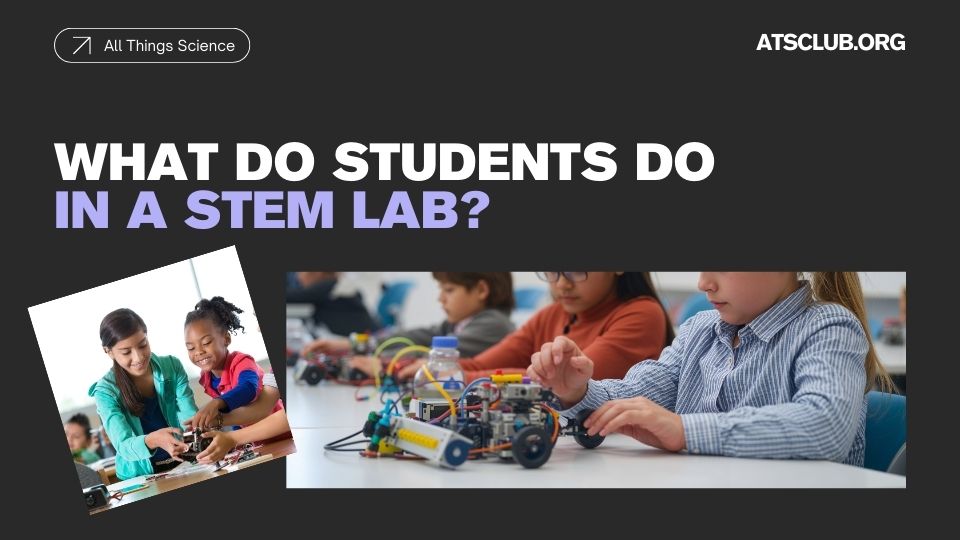
Even though STEM labs are aligned with NGSS and state standards, they serve a different purpose than traditional classroom instruction. They place greater emphasis on hands on projects, activities, and experiments rather than relying primarily on lectures or worksheets.
This gives students the opportunity to actually apply what they are learning in a way that mirrors how real scientists and engineers work in the real world.
Strong in school STEM labs typically rotate through a range of focus areas such as:
1. Rocketry and Space
Students design, build, and launch rockets while learning how thrust, drag, gravity, and aerodynamics work.
2. Robotics
Students build and program robots to complete tasks, solve challenges, and respond to inputs.
3. 3D Printing
Students design three dimensional models using CAD software and bring those designs to life with 3D printers.
4. Circuits
Students construct working circuits and explore how electricity powers devices.
5. Biology
Students investigate living systems through observation, experimentation, and data collection.
6. Chemistry
Students conduct experiments to understand matter, reactions, and changes in substances.
7. Engineering
Students design, test, and improve solutions to structured real world challenges.
8. Physics
Students explore motion, energy, forces, and simple machines through experimentation.
9. Coding
Students write code to build games, automate actions, or control devices and programs.
STEM lab benefits
As demand for STEM education continues to grow, many schools and parents feel the pressure to offer meaningful, hands on learning but run into the same barriers: limited time, limited staff bandwidth, and limited resources. Designing strong curriculum, sourcing materials, managing prep, and keeping lessons aligned to standards is a major challenge for any one teacher or administrator.
Partnering with an organization that specializes in running in-school STEM labs removes that burden while still giving students access to high quality instruction.
Benefits for schools
Schools do not need to purchase or manage curriculum, supplies, or equipment. The lab provider handles materials, lesson planning, and ongoing updates, which keeps content current and aligned with NGSS and state standards.
Teachers gain additional prep time while their students are engaged in structured STEM instruction led by a dedicated educator. There is no need for extra teacher training or added workload. The lab operates within the school day, making it accessible to more students without extending schedules or creating logistical challenges.
Because students are actively building, testing, and experimenting, overall engagement increases. That hands on experience often carries back into the regular classroom, where students show stronger interest in related math and science lessons.
Benefits for students
Students develop a clearer understanding of core math and science concepts because they apply them in real situations. Instead of only hearing about force, circuits, measurement, or data, they use those ideas to solve problems.
STEM labs also build problem solving skills. Students learn how to test ideas, identify what is not working, adjust their approach, and try again. That process builds resilience and critical thinking.
Early exposure to engineering, coding, robotics, and other technology gives students a broader view of what STEM careers look like. For many elementary and middle school students, this is their first structured introduction to those pathways.
How to start a STEM lab at your school
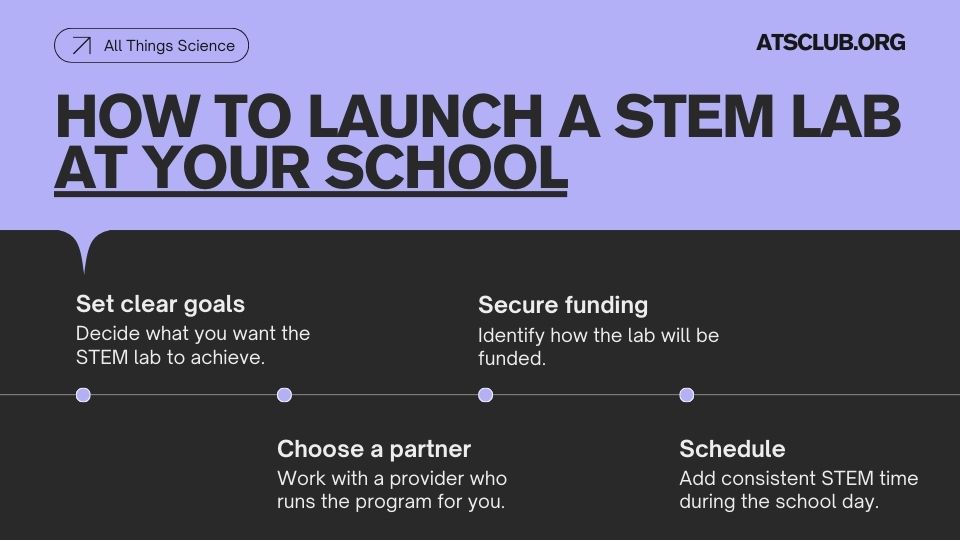
Not every school has a dedicated STEM lab, but that does not mean students have to miss out on hands-on science and engineering experiences. With the right approach, schools can launch a STEM lab without adding extra work for teachers or administrators. The key is choosing a model that fits your campus, your schedule, and your existing resources.
Below are a few practical steps to help you get started.
Assess your school’s goals and needs
Start by clarifying what you want the STEM lab to accomplish. Some schools prefer a dedicated space used by multiple grade levels, while others choose a mobile lab that rotates between classrooms. Both options can work well. What matters most is aligning the lab with your instructional goals and how your school already operates.
Choose a trusted program partner
Many schools partner with organizations that specialize in STEM labs. A strong provider handles the heavy lifting, including curriculum development, materials for every student, and trained instructors who know how to manage hands-on lessons in real classrooms. This approach allows schools to offer high-quality STEM instruction without asking teachers to design or manage the program themselves.
Identify funding sources early
STEM labs are often eligible for multiple funding streams. Schools commonly use grant funding, ELOP funds, PTA or foundation support, or district innovation budgets. Planning funding early helps ensure the program is sustainable and avoids surprises once the lab is up and running.
Build STEM time into the schedule
Consistency matters. STEM labs work best when they are part of a predictable weekly or monthly schedule for each grade level. Many schools integrate lab time during the instructional day, which can also give classroom teachers a built-in prep period while students are engaged in structured, hands-on learning.
Communicate clearly with families
Families appreciate knowing what their students are learning and why it matters. Sharing details about the lab, the types of projects students will complete, and how the program connects to real-world skills helps build excitement and support. Clear communication also reinforces the value of STEM education beyond test scores.
STEM labs with All Things Science

If your school is exploring ways to expand hands on STEM instruction, a structured in school lab can be a practical next step. The right model should fit your campus schedule, align with your academic goals, and operate without creating extra strain on teachers.
At All Things Science, we partner with elementary and middle schools to run in school STEM labs that cover subjects like rocketry, robotics, 3D printing, circuits, biology, chemistry, physics, engineering, and coding. Our team handles curriculum, materials, and instruction so schools can focus on their broader academic goals.
If you are considering launching a STEM lab at your school, we are always open to having a conversation and exploring whether it is the right fit for your campus.
STEM lab FAQ
How often do students visit a STEM lab?
Most schools schedule STEM labs on a rotating basis during regular school hours. Classes may attend once a week, twice a week, or once every few weeks depending on the school’s structure.
Do STEM labs replace regular science classes?
No. STEM labs are designed to complement classroom instruction. They reinforce grade level standards through hands on application, not replace core science curriculum.
Do teachers need special training to run a STEM lab?
If the lab is led by a specialized STEM instructor or partner organization, classroom teachers do not need additional technical training. The STEM educator leads instruction during the scheduled lab time.
What grades can participate in a STEM lab?
STEM labs can be adapted for elementary, middle, or K–8 campuses. Lessons are typically adjusted by grade level to match developmental needs and academic standards.
How are STEM labs funded?
Schools often use a combination of ELOP funds, grants, PTA or foundation support, or district level innovation budgets to support STEM lab programs.
Hands-on STEM for parents and schools
Give your students access to great after-school STEM programs year-round
Get started ➔


.jpg)
Take a Look at our Featured Articles
Dive into the vibrant world of STEM through articles from your favorite scientists and engineers, all in one place.




Join the 1000+ families enrolled in All Things Science
Tell us where to send you some free STEM resources today.


